PLANNING THE SUPPORTING
Drawing up the plan for supporting the functional capacity of older people
The care and service plan of older people is a description of the elderly’s personal situation and of the services she / he needs. Elderly-oriented care and service plan process is consists of wide, holistic supporting actions in which the carers work multi-professionally in network. In addition to this care and service plan the carer needs to draw up a concrete care plan for supporting the functional capacity.
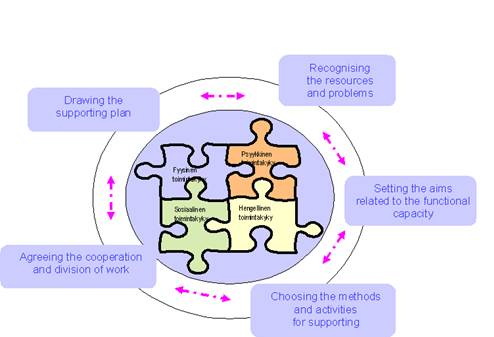
Figure. The process of drawing up a care plan for supporting the functional capacity
The care plan for supporting the functional capacity of older people is a concrete care plan, which guides the carer to support the functional capacity of older people taking into account all areas of functional capacity. In this way the carer supports concretely the coping of the elderly in daily life and activities of daily living.
The carer needs time for this challenging work. It must be completed together with the elderly, because it concerns her / his life. If needed and possible, the family members of the elderly can be interviewed. The elderly is motivated and committed to the instructions concerning his / her functional capacity when her / his voice is heard in the plan. The carer guides the elderly to see the possibilities and alternatives, which help in improving or maintaining the functional capacity.
Drawing up the supporting plan is multi-professional work, all parties are active. This guarantees a well-informed, holistic and coherent supporting plan to which all care parties can commit. The plan is based on the resources and problems of the elderly. The supporting plan guarantees the quality of support, care and nursing.
The drawing up of the supporting plan is a process. The basis lies in finding out the life story and assessing the functional capacity in all areas. When the resources and problems are found out by the analysis, the carer and the elderly set realistic and concrete aims. These aims can be evaluated by different instruments / measures.
The carer documents in the supporting plan concrete, detailed, creative and effective methods and activities for supporting the functional capacity. The professionalism of the carer comprises the understanding of the functional capacity-thinking. This enables the proficient carer to choose effective and versatile methods / activities to the supporting plan and also take them into action. It is important that the documentation is clear and all parties of care have a mutual understanding of the supporting, division of work and its principles. A well-drawn supporting plan is done in multi-professional team actively in different phases of the process and it makes it possible to all parties to commit to the supporting of the functional capacity.
The supporting, care and nursing of older people must always be based on adequate and up-dated plans. Drawing up the plan requires expertise and it must be goal-oriented. The supporting and the methods must be evaluated in different phases of the supporting process. The actions and their effectiveness must be made transparent. In addition co-operation and division of work must be paid attention to in the plan.
A qualitative supporting plan guarantees the continuity of the support and care of older people. It is dynamic and the continuous evaluation and making changes are routine actions. In this way the supporting plan is in real time and the responsible carer evaluates and up-dates the plan.
A written supporting plan is a basis for changes and adjustments which are needed in the plan. The supporting plan is a tool for co-operation parties that commit to qualitative work in supporting the functional capacity. All parties must be aware of the resources and problems of the elderly, know the aims and their responsibilities in this challenging and demanding work. The whole co-operative team must agree the division of work for the best of older people in improving and maintaining the functional capacity.
Important issues to remember in the care plan process for supporting the functional capacity are:
- Make the plan together with the elderly
- Analyse the life story and recognise the resources and problems of the elderly
- Recognise the resources and problems which have appeared from the assessments of the functional capacity
- Write them down in the plan
- Agree with the elderly the aims concerning the functional capacity
- Write down the aims in the plan
- Write down the supporting methods and activities in the plan
- Write down the division of work in the plan
- Evaluate the implemented plan at certain intervals